

H.G. Bond1*, M.E. Wengrove1 , C. Arnowil1
1 Oregon State University, USA
* Corresponding author: bondh@oregonstate.edu
Introduction
Around the world, engineers are exploring nature-based methods for mitigating coastal erosion. In high-energy wave environments, dynamic revetments, which mimic naturally occurring composite beaches, are an option for nature-based erosion control (Allan et al., 2005). Like composite beaches, dynamic revetments consist of a flat, dissipative sandy beach backed by a cobble berm. The shape of the dynamic revetment is expected to change over time as the cobbles move and the structure adjusts to the forcing conditions.
The cobble volume of a dynamic revetment has been suggested to be a predictor of the success or failure of the structure. Ahrens (1990) suggested, based on lab experiments, that the final profile shape was controlled only by the cobble volume. They provided equations, which were based on the local wave steepness and the water depth at the toe of the revetment, to calculate the critical volume of cobbles needed to protect the backshore. However, the study tested a dynamic revetment on a concrete bed, neglecting the potential influence of sand on the dynamic revetment evolution. Additionally, Ahrens (1990) was based on conditions from Lake Michigan, which has different wave and water level conditions than the high-energy outer coast.
Objective and Methods
The objective of this study is to investigate the morphological response of a dynamic revetment and sand system as a function of cobble volume. In the laboratory, we tested dynamic revetments with four cross-sectional volumes: Large (L), Medium (M), Small (S), and Extra Small (XS). The cobble front slope and crest elevation were held constant, and the cobble toe elevation and location were altered.
The scaled wave and water level conditions and the dynamic revetment geometries were based on storms with annual return periods of 20 years and 100 years, and existing dynamic revetment projects, respectively, in Oregon and Washington, USA. The morphology and wave conditions were scaled using Froude scaling (1:12). The cobbles were scaled based on their permeability, expected direction of transport, and expected mobility, leading to the choice of a well-graded distribution (D85/D15 of 2.75) with a D50 of 12 mm.
Testing for each revetment included 3000 waves at the 20-year storm conditions, and 3000 waves at the 100-year storm conditions. The flume was equipped with a line-scan lidar, which monitored the cobble profile. An overhead camera recorded the runup during the experiment, and a time-lapse camera recorded changes in the internal structure of the cross section.
Results
The front faces of both the M and L revetments (Figure 1b-c) steepened as they adjusted to wave impact. Loose cobbles were pushed on top of the revetment, causing an increase in crest height. Infilling of sand into the revetment was observed (e.g., Figure 1e), and occurred when swash with suspended sediment percolated into the revetment. The XS and S revetments (Figure 1a) had less profile adjustment and more infilling (Figure 1d) than the M and L revetments. Sand infilled the revetment, which reduced the percolation of water into the dynamic revetment, increasing overtopping. The infilling limited the mobility of the cobbles, so the process of crest-building was hindered (Figure 1a). We consider the XS and S revetments to be failures and the M and L revetments to be successes.
The Ahrens (1990) equations for critical volume were used to determine if each dynamic revetment was expected to succeed or fail. The M and L revetments, which we considered successful, were both expected to fail. The results from this study indicate that sand has an impact on the morphological response of dynamic revetments, and that successful dynamic revetments may need a smaller volume than currently predicted.
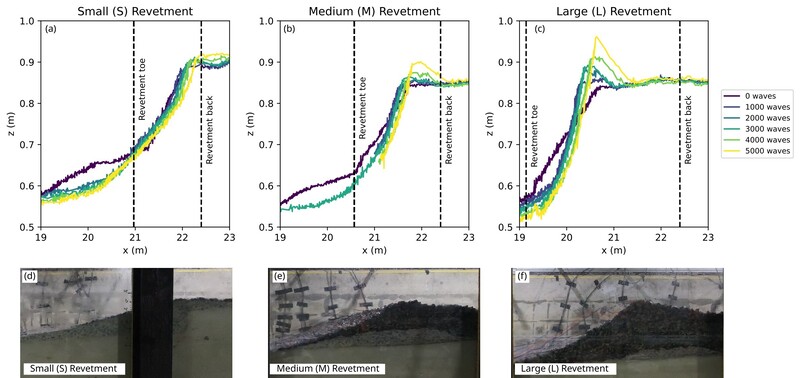
Performance of Small (a and d), Medium (b and e), and Large (c and f) revetments during testing. a-c shows the lidar-derived morphology progression throughout the test, and d-f shows photos of the final state of the revetment.
References
Ahrens, J.P., 1990. Dynamic Revetments. Coastal Engineering 1837–1850.
Allan, J.C., Geitgey, R., Hart, R., 2005. Dynamic Revetments for Coastal Erosion in Oregon.
