

K.B. Haakman1*, F. Zijl2 , M. Verlaan1,2, D.C. Slobbe1
1TU Delft, The Netherlands; 2 Deltares, The Netherlands
* Corresponding author: k.b.haakman@tudelft.nl
Introduction
In the Ems estuary, spatial variability of up to 1 mm yr⁻¹ in the rate of relative sea-level rise has been observed between tide gauge stations (1996-2022). Over the same period, tide gauge records show spatially coherent trends in the 2M2–M4 phase lag of sea surface elevation, a key indicator of tidal asymmetry. This raises the question of whether the observed changes in tidal asymmetry are linked to the spatial variability in sea-level rise within the estuary.
Objective and Methods
This study investigates whether changes in tidal asymmetry can help explain the spatial variability in relative sea-level rise within the estuary. We apply a depth-averaged hydrodynamic model (DCSM) forced with yearly bathymetry data to reproduce the observed evolution in tidal phase lags. Using tidally averaged momentum equations, we quantify how changes in tidal asymmetry generate along-estuary sea-level gradients and modify mean water levels over time.
Results
The model accurately reproduces the observed changes in 2M2–M4 phase lags and shows that the evolving tidal asymmetry increases along-estuary sea-level gradients. This contributes to approximately 7 mm of additional relative sea-level rise at the tide gauges of Delfzijl and Knock over a 26-year period. Our results demonstrate that changes in tidal asymmetry can produce spatially variable trends in mean sea level, and may represent an overlooked mechanism contributing to regional differences in observed sea-level rise.
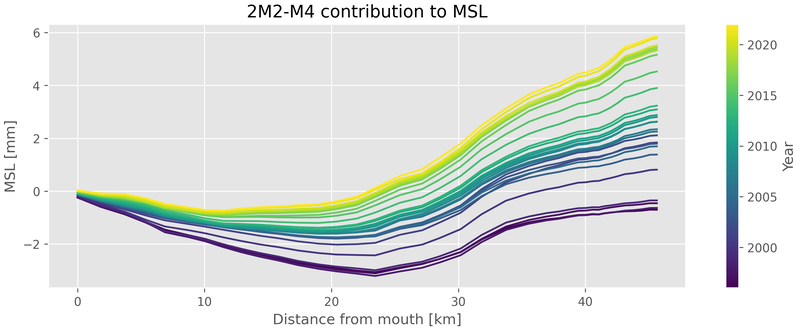
Contribution of M2-M4 interaction to mean sea level over time through quadratic bottom friction.
