
Ymkje Huismans1,2*, Zheng Bing Wang1,2, Jurre de Vries3, Martijn Klein Obbink3, Quirijn Lodder3, Edwin Elias1
1 Deltares, the Netherlands; 2 Delft University of Technology, the Netherlands; 3 Rijkswaterstaat
* Corresponding author: Ymkje.Huismans@deltares.nl
Introduction
The Dutch Wadden Sea is a highly dynamic natural system and an important habitat for many species of worldwide importance. Sediment dynamics are important for ecology, coastal management, and navigability. Despite expectations that accelerating sea‑level rise will partially drown intertidal areas on the long term (Huismans et al., 2022), many regions are presently still accreting. In the Ameland Basin, sedimentation even exceeds current sea‑level rise rate due to infilling of shallow channels, and marshes continue to expand (Ellias & de Wilde 2026). These present‑day trends stand in contrast to concerns about partial drowning under accelerated sea‑level rise, raising questions about the processes driving infilling, their basin‑wide effects, the relevant timescales, and how they will shape future development.
Objective and Methods
For studying long‑term morphodynamic development in the Wadden Sea, the ASMITA model is often used (Stive et al., 1998). It represents system dynamics on aggregated spatial and temporal scales: morphodynamics are calculated based on sub‑tidal timescales, and morphological features such as channels, intertidal flats, and the ebb‑tidal delta are represented by volume elements (see Figure, left).
This study aims to assess how well ASMITA can represent certain infilling processes, identify the mechanisms that drive them, and determine their influence on future Wadden Sea basin development. Two types of simulations are performed. First, idealised runs explore the system’s response and adjustment times to basin‑size reduction from marsh expansion, embankment or shifts in tidal watershed. Second, a hindcast is carried out for the infilling of the former Middelzee, a historic sea inlet connected to the Ameland Basin.
Results
When basin size decreases - due to for example marsh expansion, embankments or shifts in the tidal watersheds - the tidal prism and flow velocities decline, causing channels to infill. Infilling is rapid during the first decades, however reaching a new dynamic equilibrium takes centuries. If mainly high‑lying intertidal areas disappear due to marsh expansion, the remaining lower flats will also accrete as a coupled response.
The infilling of channels and flats following a reduction in basin size was likewise observed in the system’s response to the Middelzee embankment (see figure). Over several centuries, the Middelzee was progressively embanked, and historical sources report that each embankment phase triggered renewed sedimentation (van der Spek, 1994). ASMITA reproduces this behaviour, with modelled sedimentation volumes falling within the same range as the reported values. This demonstrates ASMITA’s ability to capture infilling dynamics on centennial timescales and bridges the gap between engineering and historical timescales. Given the long response times, it is likely that part of the present‑day sedimentation remains influenced by the historical embankment of the Middelzee, as well as by past decadal trends in marsh expansion and shifts in the tidal watershed.
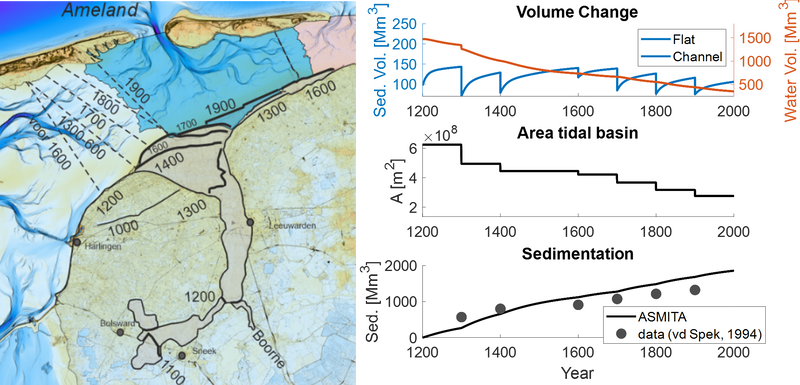
Left: Illustration of infilling and embankment of the Middelzee (Elias 2025, Van der Spek 1994). Right: response of the Ameland basin to embankment of the Middelzee, ASMITA results (lines) and measurements (dots).
References
Elias, E. (2025). Morfologische analyse Oostelijke Waddenzee. Een analyse van de kombergingen van het Amelander en Friesche Zeegat. Delft: Deltares Rapport 11210370-003.
Elias, E., en De Wilde, T., 2026 Morfologische Analyse Centrale Waddenzee. Een verdiepende studie van het Amelander Zeegat.
Huismans, Y., van der Spek, A., Lodder, Q., Zijlstra, R., Elias, E., & Wang, Z. B. (2022). Development of intertidal flats in the Dutch Wadden Sea in response to a rising sea level: Spatial differentiation and sensitivity to the rate of sea level rise. Ocean & Coastal Management, 216, 105969.
Stive, M.J.F. ,Wang, Z.B., Ruol, P., Buijsman, M.C, Morphodynamics of a Tidal Lagoon and Adjacent Coast, vol. 397, 8th International Biennial Conference on Physics of Estuaries and Coastal Seas, The Hague (1998), p. 407
Van der Spek, A.J.F., 1994. Large-scale evolution of Holocene tidal basins in the Netherlands. Proefschrift, Universiteit Utrecht.
