
S.N. Brakkee1,2
1 Utrecht University; 2Rijkswaterstaat
* Corresponding author: silke.brakkee@rws.nl
Introduction
Maintaining good water quality in the North Sea is essential for safeguarding marine ecosystem functioning. Phytoplankton play a fundamental role as primary producers, forming the base of the marine food web. However, excessive phytoplankton growth may indicate eutrophication and can negatively affect overall ecosystem health (Berdalet et al., 2017).
Seasonal stratification, characterised by the formation of a thermocline, structures the water column and influences nutrient transport and oxygen dynamics. These processes, in turn, affect phytoplankton growth and vertical distribution (Soetaert & Middelburg, 2009; Dutiel et al., 2024). Understanding this relationship is therefore crucial for interpreting phytoplankton dynamics in the North Sea.
Rijkswaterstaat (RWS) is responsible for assessing the chemical status of Dutch marine waters. Under the Marine Strategy Framework Directive (KRM) and the OSPAR Convention, RWS is required to monitor and evaluate the eutrophication status. Chlorophyll-a concentrations and algal bloom occurrence are key indicators used to assess the ecosystem condition.
In 2026, a revised monitoring strategy will be introduced, with an increased emphasis on remote sensing techniques. This transition requires improved understanding of when, where, and at which depths phytoplankton should be monitored in relation to thermocline dynamics. This research will provide scientific input to support this updated monitoring approach.
Objective and Methods
This research examines how thermocline occurrence structures phytoplankton (vertical) distribution and abundance in the Dutch North Sea and how this knowledge can support the refinement of the RWS monitoring strategy. By building on and validating existing scientific insights with long-term monitoring data, the study aims to strengthen the scientific foundation of algal bloom monitoring.
The central research question is:
How do spatial and temporal patterns of thermocline formation structure phytoplankton dynamics in the vertical water column of the Dutch North Sea?
The study integrates a literature review with long-term monitoring data analysis. The literature review will identify the key drivers of stratification and algal bloom development, providing a framework for interpreting patterns derived from the monitoring dataset. Vertical CTD profiles (1995–2024) from Rijkswaterstaat will be analysed (see Figure 1) to determine the depth, duration and spatial variability of the thermocline across the Dutch continental shelf. Discrete chlorophyll-a measurements will be used to assess phytoplankton abundance and vertical distribution. As sampling of chlorophyll-a within thermocline layers is currently limited, direct assessment of phytoplankton abundance during stratification is also limited. Therefore, this research will also investigate whether fluorescence measurements can function as an accurate proxy for phytoplankton biomass.
Results
This research is expected to provide improved insight into when and where thermoclines occur and how they influence the vertical distribution of phytoplankton in the Dutch North Sea, based on recent monitoring data. By linking physical water column dynamics to biological responses, the study will clarify how stratification shapes phytoplankton patterns (abundance and distribution) across seasons and locations.
These insights will inform practical monitoring strategies, including guidance on selecting sampling depths and determining the timing and spatial focus of monitoring campaigns. The study will therefore provide a stronger foundation on which to evaluate whether current sampling strategies effectively capture phytoplankton dynamics in stratified conditions.
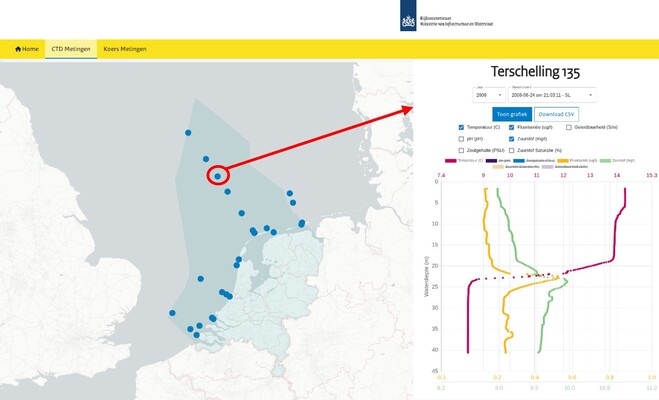
Figure 1: Spatial overview of the monitoring locations on the Dutch continental shelf, including an example of vertical CTD profile data at station Terschelling 135. The profile displays dissolved oxygen, temperature, and fluorescence (Source: Prototype viewer developed by Cas van Rijn).
References
Berdalet, E., Montresor, M., Reguera, B., Roy, S., Yamazaki, H., Cembella, A., & Raine, R. (2017). Harmful algal blooms in fjords, coastal embayments, and stratified systems: Recent progress and future research. Oceanography, 30(1), 46-57.
Duteil, O., Macias, D., Stips, A., & Polimene, L. (2024). The major role of riverine outflows in shaping the current and future habitats of Harmful Algal Blooms: the case of the North Sea. Environmental Research Communications, 6(12), 121004.
Soetaert, K., & Middelburg, J. J. (2009). Modeling eutrophication and oligotrophication of shallow-water marine systems: the importance of sediments under stratified and well-mixed conditions. Hydrobiologia, 629(1), 239-254.
