

X. Wang1, G.H.P. Campmans1, T. Weinhart2 , K.M. Wijnberg1*
1 Civil Engineering and Management, University of Twente, the Netherlands; 2 Thermal and Fluid Engineering, University of Twente, the Netherlands
* Corresponding author: k.m.wijnberg@utwente.nl
Introduction
Aeolian sediment transport has traditionally been studied through equilibrium flux laws relating saturated transport rates to wind shear velocity. However, wind-tunnel and field observations show that transport evolution toward equilibrium is often non-monotonic and strongly influenced by surface moisture (Strypsteen et al., 2024; Wang et al., 2025). Moisture modifies grain-bed interactions, splash-driven entrainment, and particle trajectories, thereby complicating transport transients and increasing critical fetch distances (Neuman and Scott 1998). While grain-scale models resolve these mechanisms explicitly, their computational cost limits their applicability at engineering scales. Existing continuum models reproduce saturated fluxes but rarely capture transient evolution under moist conditions in a physics-based manner.
Objective and Methods
This study aims to elucidate the key mechanisms governing the transient evolution of aeolian sediment transport under moist conditions at the continuum scale, by developing a dynamic continuum framework that solves for the mean saltation mass and velocity within the transport layer. The model incorporates moisture effects explicitly via splash functions derived from discrete particle model (DPM) simulations, linking grain-scale collision statistics to continuum-scale closure relations, and couples the saltation mass and velocity to an evolving airflow through drag-induced momentum exchange. Model predictions are evaluated against DPM results across a range of moisture contents and Shields numbers. A global optimization procedure is applied to calibrate two key splash closure relations, after which the performance of the calibrated model is evaluated to provide insights into the continuum-scale mechanisms of aeolian transport affected by moisture.
Results
Without additional calibration, the framework qualitatively reproduces several aspects of the transient evolution of transport under all considered moisture conditions. Improved quantitative agreement with DPM results is achieved after calibrating the splash closures. The calibration reveals that closures based solely on averaged grain-scale statistics are insufficient, as they neglect the variability of incident particle properties and the dependence of splash dynamics on the evolving transport state. The results further indicate that the bed cohesion state evolves during transport and controls distinct transport stages observed under moist conditions. Accounting for this evolving bed state and its feedback on transport dynamics is essential for accurately reproducing moisture-modified transport dynamics. Overall, the proposed framework advances the understanding of continuum-scale aeolian transport in moist environments and provides a foundation for improved predictive tools in engineering applications.
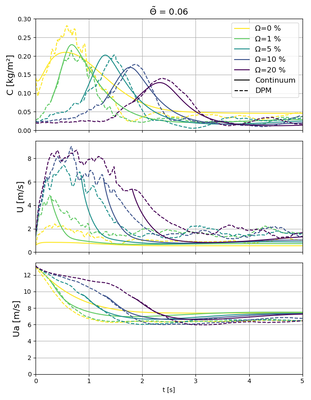
Fig1. Saltation concentration, saltation velocity, and air velocity predicted by the continuum model with calibrated splash closure relations and initialized at the time when a reference concentration is exceeded for the Shields number of 0.06 and various bed moisture contents by volume, compared to Discrete Particle Model (DPM) data from Wang et al., (2025).
References
Strypsteen, G., Delgado‐Fernandez, I., Derijckere, J., & Rauwoens, P. (2024). Fetch‐driven aeolian sediment transport on a sandy beach: A new study. Earth Surface Processes and Landforms, 49(5), 1530-1543.
Wang, X., Campmans, G. H., Weinhart, T., Thornton, A. R., & Wijnberg, K. M. (2025). A Discrete Particle Modeling Framework for Exploring the Evolution of Aeolian Sediment Transport on Moist Sand Surfaces. Journal of Marine Science and Engineering, 13(9), 1733.
Neuman, C. M., & Scott, M. M. (1998). A wind tunnel study of the influence of pore water on aeolian sediment transport. Journal of Arid Environments, 39(3), 403-419.
