
M.E.B. van Puijenbroek 1*, F.O.H. Smulders1
1 Wageningen Marine Research, Wageningen University & Research, Netherlands;
* Corresponding author: marinka.vanpuijenbroek@wur.nl
Introduction
Salt marshes of the Wadden Sea are shaped by interacting gradients of geomorphology, hydrodynamics and management, yet how these factors structure vegetation diversity across spatial scales remains poorly understood. Previous studies have shown that species–area relationships at small spatial scales are influenced by topographic heterogeneity (Ruifrok et al., 2014), but the role of geomorphology has not been assessed at larger spatial scales due to the lack of spatially consistent species richness data. As a result, the influence of large-scale geomorphological features, such as washovers and creek systems, on vegetation diversity remains largely unexplored.
Objective and Methods
Understanding scale-dependent controls on vegetation diversity is essential for effective conservation and restoration, particularly in the context of climate change, sediment management and coastal adaptation. This study therefore investigates how vegetation diversity in Wadden Sea salt marshes relates to marsh area, geomorphology, elevation heterogeneity and management across spatial scales ranging from 100 m² to 1 km².
Using harmonised GIS datasets from the QSR salt marshes (Elschot et al., 2024) and Trilawatt programmes (German Federal Ministry of Digital and Transport, 2025), TMAP vegetation type diversity was used as a proxy for species richness. TMAP vegetation types and Shannon diversity were analysed for salt marshes in the Netherlands and Germany. Relationships were assessed at both the whole-marsh scale and across nested spatial scales ranging from 100 m² to 1 km², allowing comparison among marshes of different size, origin and management. In the analysis, vegetation diversity within 16,417 spatial units of varying size was related to geomorphological features and management regimes (Figure 1).
Results
Across most marsh types, vegetation diversity increases continuously with area and does not level off within the largest spatial scales analysed, emphasising the importance of large and wide salt marshes for maintaining diverse vegetation. Barrier-connected and chenier marshes show the highest diversity. Marshes with natural creek systems consistently support higher vegetation diversity than marshes with man-made drainage networks, with the strongest contrasts observed at the largest spatial scale. Management effects are present, but smaller than those of marsh area and geomorphology; minimum intervention and moderate grazing generally support higher diversity than intensive grazing or mowing. Restoration increases Shannon diversity and reduces occurrence of dominant vegetation types.
Elevation heterogeneity affects vegetation diversity at intermediate spatial scales, where increased variability in surface elevation is associated with a greater number of vegetation types. At very small spatial scales, diversity is constrained by the limited number of vegetation types present, while at large spatial scales gradual elevation gradients reduce contrasts in elevation heterogeneity between marsh types. Washovers enhance small-scale elevation heterogeneity and are linked to higher vegetation diversity in barrier-connected marshes. Overall, the results highlight the scale-dependent importance of geomorphology and marsh size for sustaining vegetation diversity in Wadden Sea salt marshes.
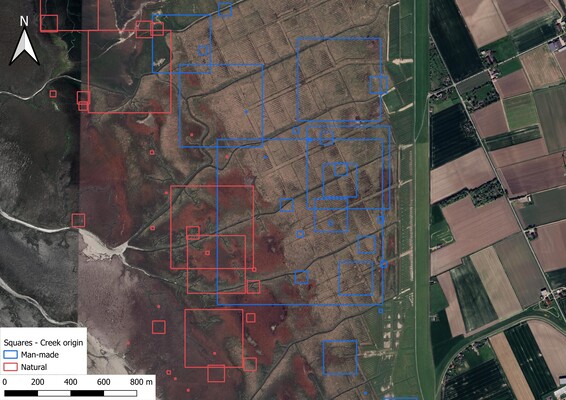
Figure 1. Example photograph of randomly placed squares of different sizes. Squares of the same size did not overlap. Color indicates creek origin.
References
Elschot, K., Esselink, P., Jensen, K., Janinhoff-Verdaat, N., Paarup Thomsen, M., Padlat, M., Van der Wal, J. T., van Duin, W. E., Van Puijenbroek, M. E. B., Rupprecht, F., & Stock, M. (2024). Salt marshes. In Wadden Sea Quality Status Report. Eds.: Kloepper S. et al. Common Wadden Sea Secretariat.
German Federal Ministry of Digital and Transport. (2025). Digitaler Zwilling des trilateralen Wattenmeers—TrilaWatt. https://trilawatt.eu/
Ruifrok, J. L., Postma, F., Olff, H., & Smit, C. (2014). Scale-dependent effects of grazing and topographic heterogeneity on plant species richness in a Dutch salt marsh ecosystem. Applied Vegetation Science, 17(4), 615–624. https://doi.org/10.1111/avsc.12107
