W. Harms1, A. Bartholomä2, J Bulens3*, F. Bungenstock4, F. Dunn3, H. Freund1, M. Fruergaard5, M. Karle4, K. Maxwell2 , J. Nienhuis3, M Oostra4,6, M. H. Sarker6, F. J. Sijtsma6, A. Traue1, A. Wehrmann2, D. Giebels1
1 Institute of Chemistry and Biology of the Marine Environment, University of Oldenburg, Oldenburg, Germany; 2 Marine Research Department, Senckenberg am Meer (SaM), Wilhelmshaven, Germany; 3 Department of Physical Geography, Utrecht University, Utrecht, The Netherlands; 4 Lower Saxony Institute of Historical Coastal Research, Wilhelmshaven, Germany; 5 Department of Geosciences and Natural Resource Management, University of Copenhagen, Copenhagen K, Denmark; 6 Faculty of Spatial Sciences, Rudolf Agricola School for Sustainable Development, University of Groningen, Groningen, The Netherlands
* Corresponding author: j.bulens@uu.nl
Introduction
This poster presents an overview of the transdisciplinary structure and selected methodologies applied in the trilateral project WAD was – WAD can we do? (WADWAD). The WADWAD project brings together a transdisciplinary think tank to integrate existing data and knowledge on sediment dynamics, coastal adaptation strategies, and social acceptability assessments to develop an ecosystem-based Sediment Action Plan. At the core of WADWAD is the integration of knowledge about historical transformations, current sediment conditions, and future projections.
Objective and Methods
In order to achieve its objectives, the project will apply a range of methodologies, including the synthesis of sediment core archives, stakeholder reports, sediment modeling, and the creation of heat maps to identify areas under pressure. Fieldwork at selected case study sites, combined with stakeholder engagement, will further support the development of management options and adaptive pathways. Central to the project is a structured transdisciplinary process, designed to build a shared understanding of sediment transformations and support knowledge integration across national and disciplinary boundaries. To highlight the importance of this approach the poster will present an overview of the methodologies applied to foster collaboration across scientific disciplines, policy sectors, and societal actors.
Results
Moving beyond isolated national efforts, WADWAD supports trilateral cooperation and knowledge exchange. By bridging scientific research, participatory design, and community engagement, WADWAD will foster trilateral cooperation and deliver actionable insights for sustainable coastal management, strengthening the long-term resilience of the Wadden Sea Region.
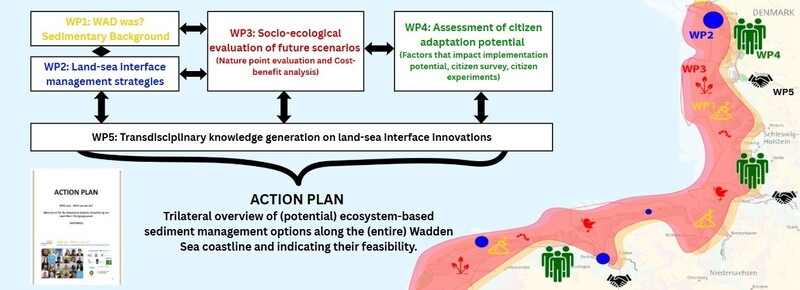
Overview of the different work packages
