
F.P. de Wit1*, E. Bijl2 , M.J.G. van den Boomgaard1, D.C. Heineke2, R.M. Veldhuizen3, D.W. McParland4
1 Svasek Hydraulics, Netherlands; 2 CDR International, Netherlands; 3 Deltares, Netherlands; 4 Ward & Burke,Ireland
* Corresponding author: wit@svasek.com
Introduction
Inis Oírr, one of the three Aran Islands, located off the west coast of Ireland, is directly exposed to long-period Atlantic Ocean swell. Although the ferry harbour is positioned on the sheltered side of the island, the existing vertical caisson breakwater experiences substantial wave overtopping during energetic swell events. This affects ferry operability, safety and, consequently, the reliability of the island’s connection to the mainland.
The breakwater is therefore being redesigned. Two key challenges arise. First, long ocean swell waves diffract around the island, requiring detailed numerical modelling for determination of near-structure design conditions. Second, overtopping prediction for peak periods up to 25 s and very low wave steepness falls partly outside the principal calibration range of commonly applied empirical formulae.
This study evaluates the performance of different overtopping prediction approaches for extremely long swell waves. Both the present vertical caisson layout and a proposed redesign — incorporating an increased crest level and an Xbloc revetment in front of the existing structure — are considered.
Objective and Methods
The objective of this study is to assess the accuracy and consistency of different overtopping prediction methodologies under extremely long-period swell conditions, and to evaluate their applicability for the redesign of the Inis Oírr breakwater.
Four approaches are compared. First, overtopping discharge is predicted using the Overtopping Manual (EurOtop, 2018) formulation for vertical and composite structures, both in its standard form and including recent adjustments proposed by Eldrup et al. (2022). Second, overtopping is derived directly from phase-resolving SWASH simulations (Zijlema, 2011). Third, hybrid approaches are applied in which SWASH is used to determine near-toe wave parameters, after which overtopping discharge is calculated using the EurOtop-based formulae.
All numerical and empirical predictions are validated against physical flume measurements. The analysis is performed for both the existing vertical caisson breakwater and the proposed redesign with increased crest height and an Xbloc armour layer in front of the structure.
Results
The preliminary comparison reveals systematic differences between the investigated approaches when applied to extremely long and low-steepness swell waves. Standard EurOtop predictions show sensitivity to the chosen wave parameters and tend to deviate from flume measurements for the longest peak periods. The adjustments proposed by Eldrup et al. (2022) improve consistency for certain conditions but do not eliminate discrepancies across the full range of tested conditions.
Direct SWASH-based overtopping predictions capture long-wave transformation and non-linear processes more explicitly, yet remain sensitive to model settings and resolution. The hybrid approach reduces part of the bias by combining detailed wave transformation modelling with established overtopping formulae, resulting in improved agreement with measurements for both structural configurations. The exact comparison between the different approaches will be presented at NCK days.
For the redesigned breakwater, the increased crest level combined with the Xbloc revetment significantly reduces overtopping discharge compared with the existing caisson layout. The study highlights the limitations of standard empirical methods for extreme long-period swell and underlines the value of integrated numerical–physical assessment in such conditions.
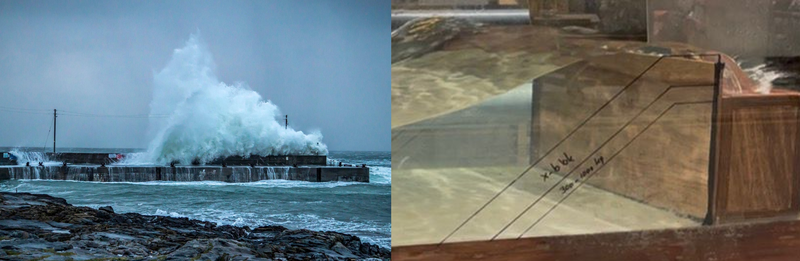
Overtopping at Inis Oirr breakwater as observed in the field (left) and the lab (right).
References
Eldrup, M. R., Andersen, T. L., Van Doorslaer, K., & Van der Meer, J. (2022). Improved guidance on roughness and crest width in overtopping of rubble mound structures along EurOtop. Coastal Engineering, 176, 104152.
EurOtop, 2018. Manual on wave overtopping of sea defences and related structures. An overtopping manual largely based on European research, but for worldwide application.
Zijlema, M., Stelling, G., & Smit, P. (2011). SWASH: An operational public domain code for simulating wave fields and rapidly varied flows in coastal waters. Coastal Engineering, 58(10), 992-1012.
